
Common Symptoms
- Medial knee pain at or below the joint line after a valgus stress
- Swelling and bruising along the inner side of the knee
- Valgus instability — feeling the knee buckle inward when planting or pivoting
- Tenderness to touch over the medial femoral epicondyle or medial joint line
- Pain reproduced with valgus stress test at 30 degrees of knee flexion
- Reluctance to fully weight-bear immediately after injury in higher-grade tears
MCL Tear on MRI: AI-Powered Imaging Analysis
AI-powered MCL (medial collateral ligament) tear analysis on knee MRI. Understand Grade 1, 2, and 3 injuries, how they differ from ACL tears, and associated meniscus findings.
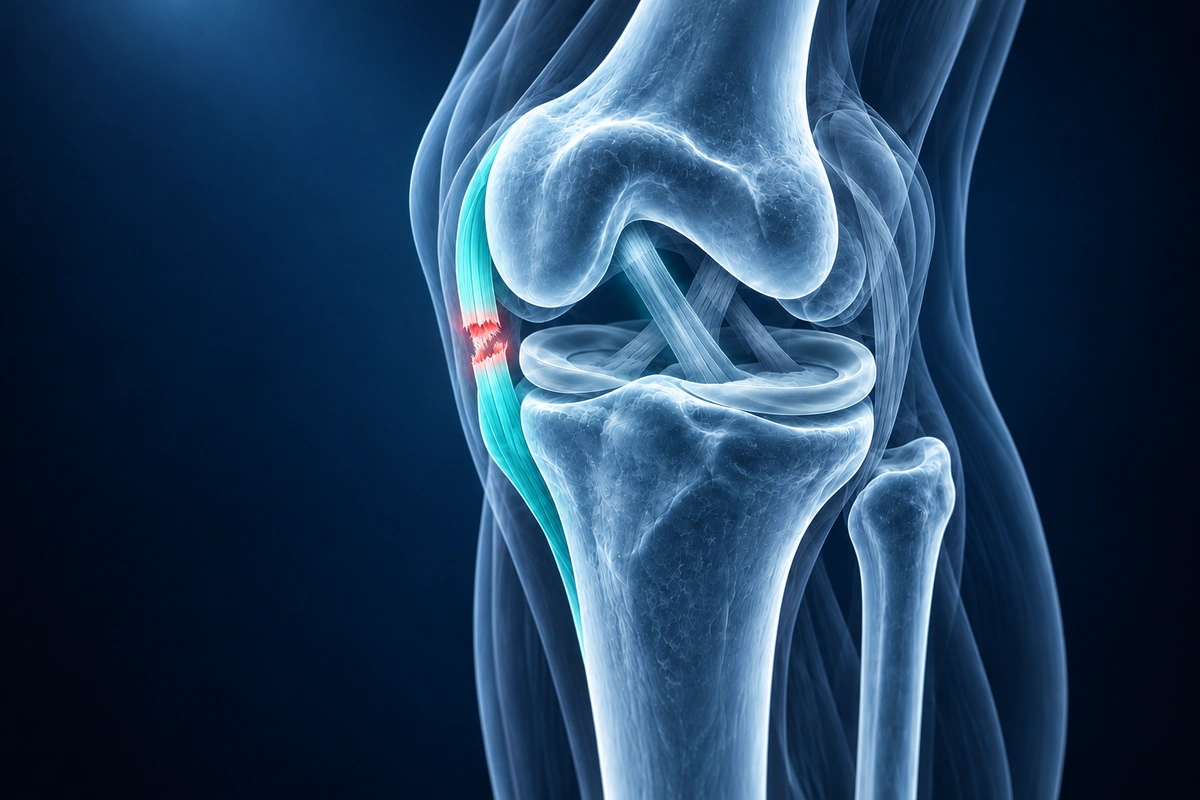
The medial collateral ligament (MCL) is the primary stabilizer against valgus (knock-knee) forces at the knee. It runs from the medial femoral epicondyle to the medial tibia and is most commonly injured when the knee is struck from the outside — classic mechanisms include a lateral tackle in football, a ski fall with the binding holding, or a direct blow that forces the knee inward. Unlike ACL tears, the vast majority of MCL injuries heal without surgery because the medial compartment has a good blood supply; the question on MRI is how severely the ligament is damaged and whether associated structures are involved. Our AI consortium evaluates coronal and axial MRI sequences to grade ligament disruption, identify avulsion sites, and flag concurrent ACL or meniscus injuries that change the treatment plan.
What We Look For on Imaging
- MCL fiber discontinuity or abnormal thickening on coronal fat-suppressed sequences, indicating partial or complete tear
- Periligamentous edema — bright signal surrounding the MCL on fluid-sensitive sequences — reflecting the degree of soft-tissue injury
- Deep MCL (meniscotibial ligament) avulsion from the tibial attachment, which is associated with increased rotational instability
- Bone bruise on the lateral femoral condyle and proximal tibia from the valgus impaction mechanism, confirming the injury pattern
- Medial meniscus tear or posterior horn displacement, as the MCL and medial meniscus share capsular attachments and are often injured together
- Associated ACL tear in combined knee injuries (multi-ligament pattern), which significantly alters prognosis and typically requires surgical planning
Frequently Asked Questions
Can an MCL tear heal without surgery?
Yes — the great majority of isolated MCL tears, including complete Grade 3 ruptures, heal successfully with non-operative treatment. The MCL has robust vascularity and a strong intrinsic healing capacity. Standard treatment is a hinged knee brace (to protect against further valgus stress), weight-bearing as tolerated, and a structured physiotherapy program focused on quadriceps and hamstring strengthening. Grade 1 and 2 injuries typically heal in 2–6 weeks; Grade 3 tears take 6–12 weeks. Surgery is generally reserved for MCL avulsions that retract away from the bone and cannot heal in apposition, or for combined multi-ligament injuries where the MCL requires repair or reconstruction alongside other structures.
How is MCL tear grade determined on MRI?
MCL tears are graded 1 through 3 on MRI based on the extent of ligament disruption. Grade 1: the ligament is intact but surrounded by edema; fibers are stretched but continuous. Grade 2: partial fiber disruption with remaining intact fibers visible; the ligament may appear thinned or heterogeneous on coronal sequences. Grade 3: complete fiber discontinuity with no identifiable intact ligament bridge; a gap or mass of disorganized signal replaces the normal taut band. The deep MCL (meniscotibial and meniscofemoral ligaments) is assessed separately, as isolated deep MCL tears with an intact superficial MCL carry a different prognosis.
Do I need surgery for a Grade 3 MCL tear?
Usually not, if the MCL tear is isolated. Even complete Grade 3 MCL ruptures typically heal with bracing and rehabilitation because the torn ends remain in close enough proximity to heal with scar tissue. Surgery becomes more likely when the MCL tear is part of a multi-ligament injury — for example, a combined ACL and MCL tear where both structures fail to provide stability, or when there is a proximal avulsion where the ligament end retracts significantly. Your orthopedic surgeon will assess clinical valgus instability at follow-up (typically 4–6 weeks) to determine whether the MCL is healing adequately; if significant laxity persists, surgical reconstruction may be considered.
Upload your knee MRI to check for MCL Tear
Upload your MRI or X-ray DICOM files for private, AI-powered analysis. 4 models analyze independently — all data stays in your browser.
Upload & AnalyzeMedical Disclaimer: This page is for informational and educational purposes only. It does not constitute medical advice, diagnosis, or treatment. AI-generated analysis may contain errors. Always consult a qualified healthcare professional for medical decisions. Full Disclaimer