
Knee MRI Cost: What to Expect in 2026
Knee MRI cost ranges, what affects price (3T vs 1.5T, contrast, hospital vs imaging center), insurance coverage, and how to lower your out-of-pocket cost.

A knee MRI in the United States typically costs between $400 and $3,500 depending on where you have it done and whether you're paying cash or using insurance. If you have insurance with a met deductible, your out-of-pocket share is often $300–$800. If you've just received an MRI order and are staring at a price estimate that seems unreasonably high, you're not imagining it — prices vary by a factor of five or more between facilities in the same city.
The single biggest driver of cost is where you get the scan: hospital radiology departments charge dramatically more than standalone outpatient imaging centers for identical equipment and identical image quality. Geographic region matters too — urban Northeastern facilities skew higher, Midwest and South lower. Adding contrast agent (gadolinium) or an MR arthrogram adds $200–$500 on top of the base price.
Typical Cost Ranges
These are honest national averages based on publicly available chargemaster data and patient-reported costs. Your actual bill will depend on your specific facility, region, and insurance plan.
- Hospital outpatient radiology department: $1,000–$3,500 (chargemaster list price); this is the most expensive setting even though the scan is identical
- Freestanding outpatient imaging center: $400–$1,500; same accreditation (ACR), same field strengths, same DICOM files — often 2–3× cheaper than a hospital
- With insurance (in-network, after deductible): $100–$400 coinsurance typical; if your deductible is not yet met, you pay the negotiated rate, usually $400–$800
- Cash / self-pay discount: most facilities offer 30–60% off the list price when you pay cash upfront — always ask before scheduling
- MR arthrography (contrast injected into the joint, used for labral/cartilage assessment): $1,200–$4,500 at hospital; $700–$2,000 at imaging center — the most expensive knee MRI variant
What Affects the Price
Understanding what drives price lets you ask the right questions before you book.
- Magnet strength (1.5T vs 3T): 3 Tesla scanners produce sharper images for knee cartilage and small ligament detail, but cost $100–$300 more than 1.5T. For most routine knee injuries (meniscus, ACL), 1.5T is adequate. Your orthopedist may specifically request 3T for cartilage mapping or small partial tears.
- With vs without contrast: Standard knee MRI (CPT 73721) is without contrast. With contrast (CPT 73723) adds gadolinium injection and costs $200–$500 more. Contrast is rarely needed for routine ligament or meniscus evaluation — it is used mainly when infection, tumor, or post-surgical change is suspected.
- MR arthrography: The radiologist injects diluted gadolinium directly into the knee joint before scanning. This is the most expensive variant and is specifically ordered to evaluate cartilage defects or suspected loose bodies — not routine.
- Weekend and after-hours surcharges: Some facilities add 10–25% for weekend or evening slots. If your injury is not urgent, a weekday morning appointment is cheaper.
- Radiologist read fee: The scan facility fee and the radiologist interpretation fee are often billed separately. The read fee is usually $100–$300 and may come from a different insurance provider network — always ask if both are in-network.
Hospital vs Outpatient Imaging Center
This is the highest-impact choice you can make. A hospital-affiliated outpatient radiology department typically charges 2–3× more for the same knee MRI than a freestanding imaging center. The difference is not quality — it is billing structure. Hospitals carry facility fees that freestanding centers do not.
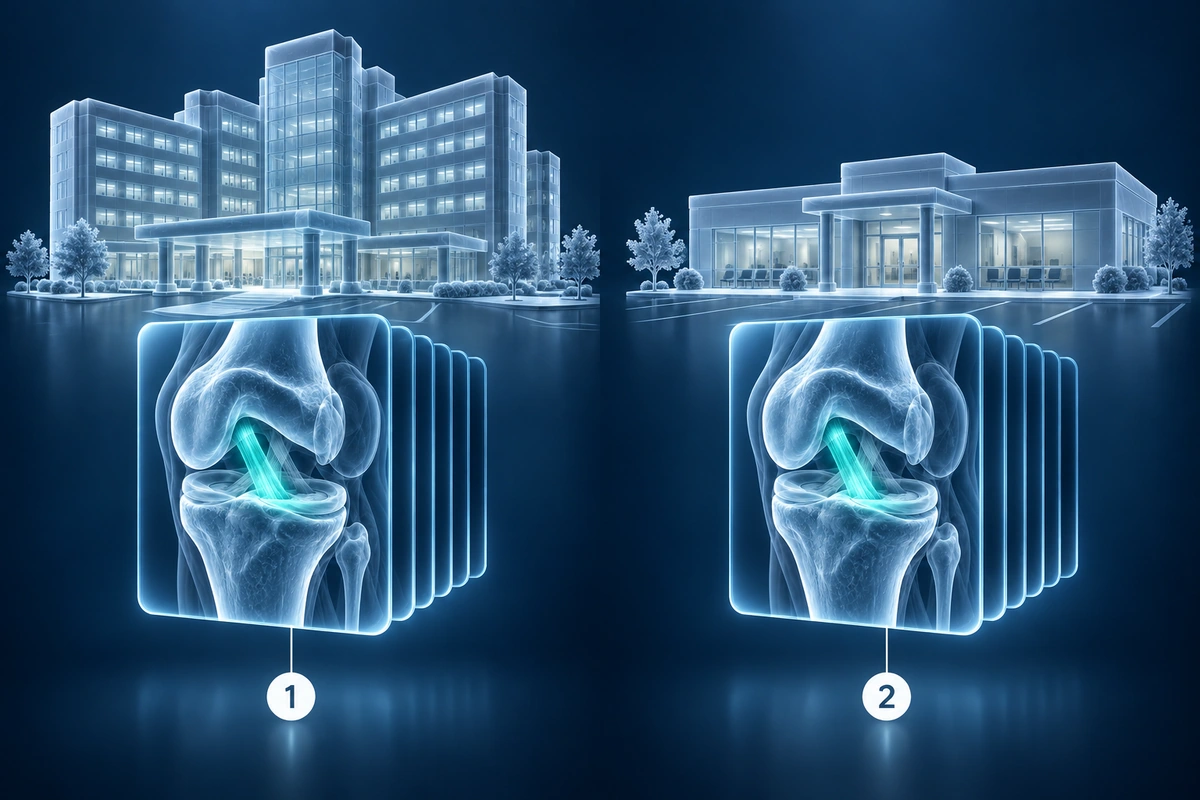
Freestanding imaging centers are accredited by the American College of Radiology (ACR) under the same standards as hospital departments. They produce the same DICOM image files on the same (often identical model) scanners. Your orthopedic surgeon can read the images from either setting; the quality difference in routine cases is negligible. If your doctor orders a knee MRI, ask specifically: "Can I have this done at an outpatient imaging center instead of the hospital?" In most cases, the answer is yes.
One exception: if your doctor suspects a complex finding that may go directly to same-day surgery, having the MRI done at the hospital where the surgeon operates can save coordination time. For everything else, the freestanding center is the financially rational choice. Once you have your DICOM files, you can also use an AI analysis tool — such as this one — to get a preliminary read before your specialist appointment. See how to read your knee MRI for guidance on interpreting the images yourself.
Insurance: What You Need to Know
Most private insurance and Medicare plans cover knee MRI when medically necessary, but the path to coverage has several steps that can trip you up.
- Prior authorization: The majority of insurance plans require prior authorization before a knee MRI. Your ordering physician submits this request — it can take 1–5 business days. Skipping this step means the scan may be denied entirely. Confirm authorization is approved before you show up.
- Deductible vs coinsurance: If your annual deductible is not yet met, you pay the full negotiated rate (not the list price — the insurer's contract rate). Once your deductible is met, you pay only your coinsurance percentage (typically 10–30% of the negotiated rate) up to your out-of-pocket maximum.
- In-network vs out-of-network: An out-of-network imaging center can cost you 2–4× more in cost-sharing. Always confirm the facility and the radiologist group are both in-network with your plan before booking.
- CPT codes to know: 73721 is the standard knee MRI without contrast. 73723 is knee MRI with contrast. 27370 is the arthrogram injection procedure billed separately from the MRI. Knowing these codes lets you verify exactly what your insurer will pay for before you schedule.
Practical Cost-Lowering Tips
These are concrete actions that routinely save patients $200–$1,500 on a knee MRI.
- Request the cash price explicitly. Call the facility and say: "What is your self-pay or cash discount rate for CPT 73721?" Many facilities have a cash price that is 30–60% below their standard chargemaster rate — but they will not offer it unless you ask.
- Shop multiple imaging centers within 30 miles. Prices within the same metro area vary enormously. Call three or four freestanding centers and compare. RadiologyInfo.org and FairHealth Consumer (fairhealthconsumer.org) let you look up fair-price benchmarks by zip code.
- Check MDsave and NewChoiceHealth. These platforms pre-negotiate cash bundles with imaging centers; you often pay $350–$700 for a knee MRI with no insurance required. The scan is identical — same facility, same radiologist.
- Use your HSA or FSA. MRI costs are always HSA/FSA-eligible medical expenses. If you have funds in a health savings account, pay from there to use pre-tax dollars — effectively a 22–37% discount depending on your tax bracket.
- Ask about hospital financial assistance. If you are uninsured or underinsured and the scan must be done at a hospital, ask for the financial counselor. Nonprofit hospitals are required by the ACA to offer financial assistance programs; many will reduce or forgive the bill based on income.
- Ask if you can bring outside images for re-read. If you already have a knee MRI from another facility, your orthopedic surgeon can often request a formal re-read by a musculoskeletal radiologist on those existing images, avoiding a repeat scan entirely. Ask before scheduling a new MRI.
For context on whether you actually need an MRI vs an X-ray for your knee injury, see our guide on MRI vs X-ray: when to use each.
Key Takeaways
- Hospital radiology departments charge 2–3× more than freestanding imaging centers for the same knee MRI — choosing the right facility is the single biggest cost lever
- Always ask for the self-pay cash price; 30–60% discounts off the list price are common and are not offered unless you ask
- CPT 73721 (without contrast) covers most knee MRI indications; contrast (73723) adds $200–$500 and is rarely needed for routine ligament or meniscus evaluation
- Confirm prior authorization is approved and that both the facility and the radiologist group are in-network before your appointment
- MDsave, NewChoiceHealth, and FairHealth Consumer let you compare and pre-purchase cash-price bundles, often $350–$700 for a knee MRI
- HSA and FSA funds cover MRI costs; using pre-tax dollars is effectively a 22–37% additional discount depending on your tax bracket
Frequently Asked Questions
Does insurance cover a knee MRI?
Yes, most private insurance, Medicare, and Medicaid plans cover knee MRI when it is medically necessary — meaning your doctor has documented that you have knee pain, injury, or symptoms that warrant imaging. Coverage almost always requires prior authorization from your insurer before the scan. Without authorization, the claim may be denied. Your out-of-pocket cost depends on your deductible, coinsurance rate, and whether you use an in-network facility. Call your insurer before scheduling to confirm coverage and ask what your estimated cost-share will be.
Do I need contrast for a knee MRI?
For most knee indications — ACL or meniscus tears, cartilage assessment, bone bruise, ligament injuries — contrast is not needed and is not routinely ordered. Gadolinium contrast (or intra-articular arthrogram contrast) is typically reserved for suspected infection, tumor, or post-surgical evaluation where enhancement patterns add diagnostic information. If your doctor ordered a standard knee MRI, it is almost certainly without contrast (CPT 73721). MR arthrography (contrast injected into the joint) is a separate, more expensive procedure specifically for detailed cartilage and labral evaluation.
Can I shop around after my doctor orders the MRI?
Yes. An MRI order from your doctor is not tied to a specific facility. You can take that order to any accredited imaging center that accepts your insurance or offers a cash price you can afford. The only constraint is that the facility must be authorized by your insurer (or you pay cash). Call multiple centers with your CPT code (73721 for standard knee MRI without contrast) and ask for their cash price and your estimated insurance cost-share. Prices within the same city can differ by $1,000 or more — shopping is absolutely worth the 20-minute effort.
What is the cost difference between 1.5T and 3T MRI?
3 Tesla scanners typically add $100–$300 to the cost of a knee MRI compared to 1.5T. Whether the upgrade is worth it depends on your clinical question. For standard ACL, meniscus, and collateral ligament evaluation, 1.5T is generally sufficient and widely accepted by orthopedic surgeons. 3T becomes more useful when your surgeon needs high-resolution cartilage mapping, assessment of small osteochondral defects, or detection of subtle partial ligament tears. If your doctor does not specifically request 3T, ask whether 1.5T would be adequate — it often is and will save you money.
What if I cannot afford a knee MRI even at cash price?
Several options exist. First, ask whether your orthopedist can begin treatment based on clinical examination and X-ray alone — for some presentations, MRI can be deferred or avoided entirely. Second, if the MRI must be done at a hospital, ask to speak with the financial counselor or patient advocate before scheduling: nonprofit hospitals are legally required (under the ACA) to offer charity care or discounted payment plans. Third, MDsave.com bundles cash-pay MRI appointments at contracted facilities for as low as $350 in some markets — no insurance needed. Finally, ask your doctor if a payment plan through the imaging facility is available; many offer interest-free installments for medical bills under $2,000.
Related Articles
Learn to understand your knee MRI report, common sequences, and what key findings mean for your diagnosis.
Compare MRI and X-ray imaging, understand when each is appropriate, radiation considerations, cost, and diagnostic capabilities.
Learn the difference between a licensed radiology second opinion and an AI MRI report explanation, when each helps, and what questions to ask your clinician.
Related Conditions
Ready to analyze your imaging? Upload your MRI or X-ray for AI-powered analysis
Upload your MRI or X-ray DICOM files for private, AI-powered analysis. 4 models analyze independently — all data stays in your browser.
Start AnalysisMedical Disclaimer: This page is for informational and educational purposes only. It does not constitute medical advice, diagnosis, or treatment. AI-generated analysis may contain errors. Always consult a qualified healthcare professional for medical decisions. Full Disclaimer