
Can a Meniscus Tear Heal on Its Own?
Understand which meniscus tears can heal naturally, the role of blood supply zones, and when surgical repair is recommended.
Key Takeaways
- Tears in the outer vascular region (red-red zone) have the best natural healing potential
- Tears in the inner avascular region (white-white zone) have very limited self-repair capacity
- Degenerative tears in patients over 40 respond equally well to physiotherapy as surgery
- When surgery is needed, meniscus repair is preferred over meniscectomy
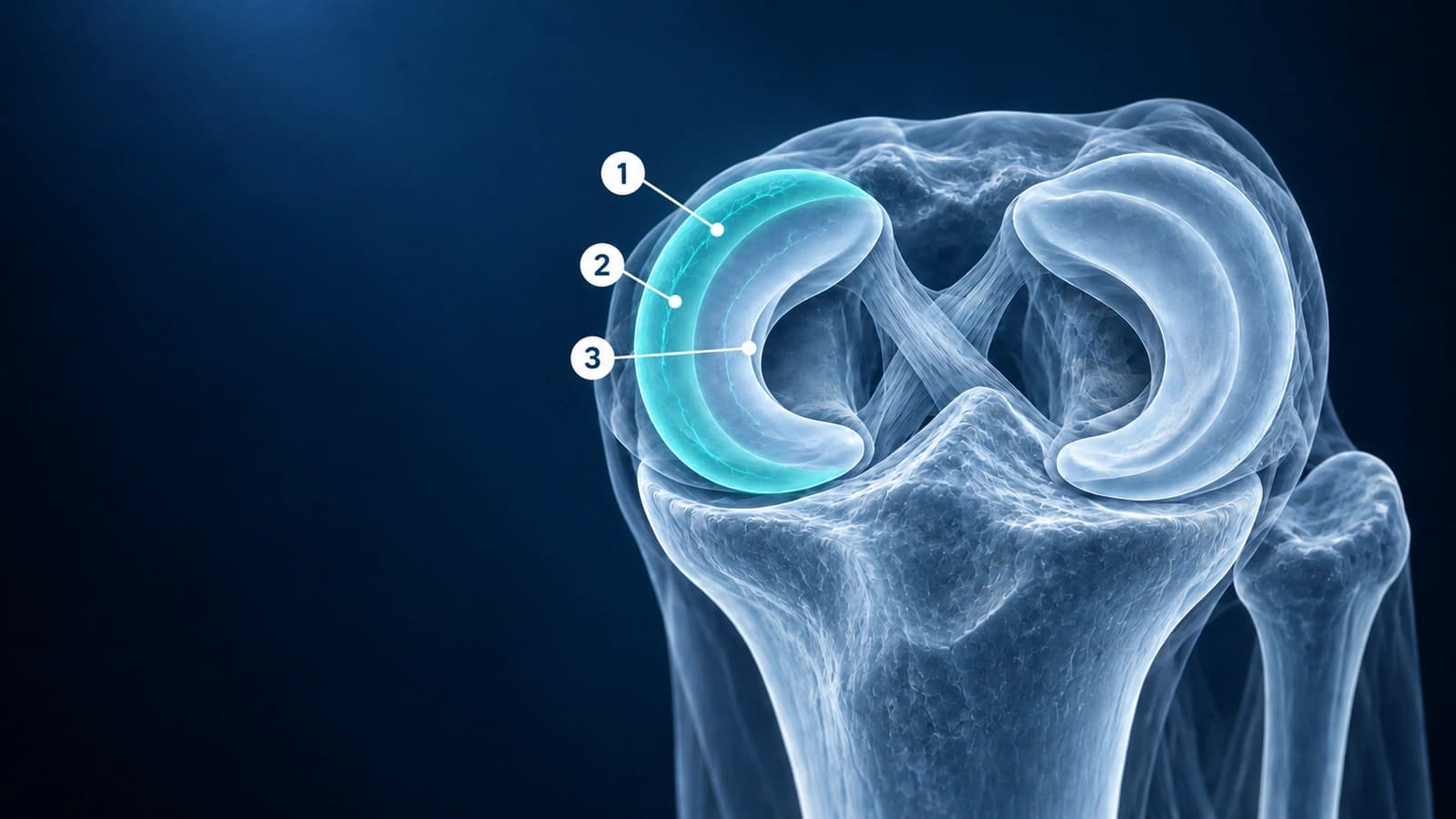
The meniscus is a C-shaped wedge of cartilage in the knee that acts as a shock absorber between the femur and tibia. Whether a meniscus tear can heal on its own depends largely on where the tear occurs. The outer red-red zone has a direct blood supply and the best healing potential. The red-white zone is transitional, and the inner white-white zone lacks a direct blood supply and has limited self-repair capacity. These regions are not equal thirds.
Types of Meniscus Tears and Healing Potential
Tear morphology significantly affects prognosis. For a comprehensive overview, see our guide on meniscus tear types explained.
- Longitudinal tears in the red zone: best healing potential, especially small stable tears under 1 cm
- Horizontal cleavage tears: moderate potential if peripheral, often degenerative
- Radial tears: poor healing as they disrupt circumferential hoop strength fibers
- Complex tears: multiple patterns combined, generally poor healing potential
- Bucket handle tears: displaced longitudinal tears requiring surgical intervention
Conservative Management Protocol
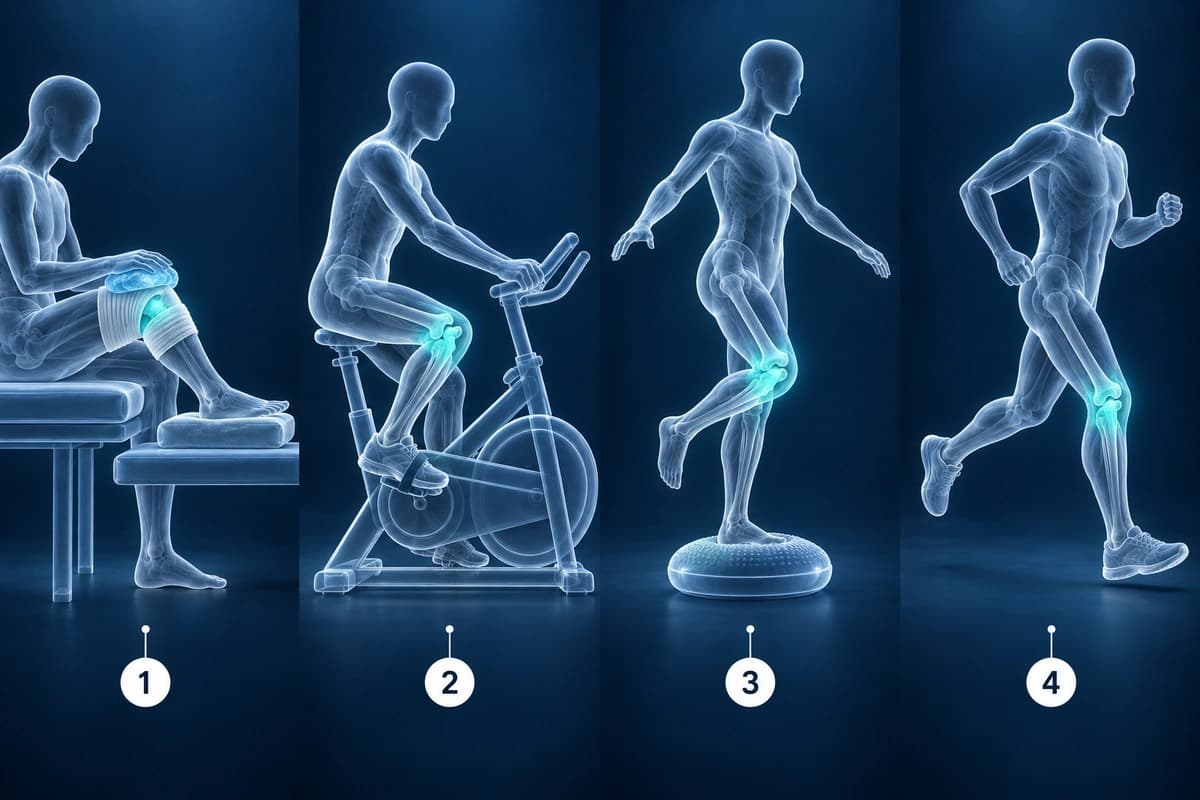
- Weeks 1-2: RICE protocol, protected weight-bearing, gentle range of motion exercises
- Weeks 2-6: Progressive strengthening, stationary cycling, pool exercises
- Weeks 6-12: Functional exercises, balance training, gradual return to low-impact activities
- Months 3-6: Sport-specific training if applicable, monitoring for recurrent symptoms
Degenerative Meniscus Tears
Degenerative meniscus tears are common in patients over 40 and often occur without specific trauma. Large randomized trials show arthroscopic partial meniscectomy provides no significant benefit over physiotherapy alone for degenerative tears. A degenerative tear is often an early sign of arthritis rather than an isolated injury. For more on arthritis grading, see our Kellgren-Lawrence osteoarthritis grading guide.
When Surgery Becomes Necessary
Surgery is recommended when conservative treatment fails after 6-12 weeks, when mechanical symptoms like locking impair daily function, when the tear is large and displaced, or when it occurs alongside an ACL tear requiring reconstruction. Modern surgical philosophy strongly favors meniscus repair over removal. Learn more about interpreting findings in our guide to reading knee MRI.
Frequently Asked Questions
How long does a meniscus tear take to heal without surgery?
Small red zone tears may improve within 6-12 weeks with proper rehabilitation. Full tissue maturation takes 3-6 months. Degenerative tears managed conservatively may not structurally heal but symptoms often improve within 8-12 weeks.
Can you exercise with a torn meniscus?
Yes, but the type matters. Swimming, stationary cycling, and straight-line walking are generally safe. Avoid deep squats, pivoting movements, and high-impact running until symptoms resolve.
Will a meniscus tear get worse if left untreated?
Stable degenerative tears may remain unchanged for years. However, unstable tears can propagate: a small radial tear can become complex, and an undisplaced longitudinal tear can evolve into a displaced bucket handle tear causing sudden knee locking.
Does a meniscus tear always show up on MRI?
A meta-analysis found MRI sensitivity of 89% for medial meniscal tears and 78% for lateral meniscal tears. MRI can miss tears, so symptoms and clinical assessment still matter.
Sources
- Arnoczky SP, Warren RF. Microvasculature of the human meniscus. Am J Sports Med. 1982;10(2):90-95.
- Sihvonen R, Paavola M, Malmivaara A, et al. Arthroscopic partial meniscectomy versus sham surgery for a degenerative meniscal tear. N Engl J Med. 2013;369(26):2515-2524.
- Katz JN, Brophy RH, Chaisson CE, et al. Surgery versus physical therapy for a meniscal tear and osteoarthritis. N Engl J Med. 2013;368(18):1675-1684.
- Beaufils P, Becker R, Kopf S, et al. The knee meniscus: management of traumatic tears and degenerative lesions. EFORT Open Rev. 2017;2(5):195-203.
- Phelan N, Rowland P, Galvin R, O'Byrne JM. A systematic review and meta-analysis of the diagnostic accuracy of MRI for suspected ACL and meniscal tears of the knee. Knee Surg Sports Traumatol Arthrosc. 2016;24(5):1525-1539.
Related Articles
Your MRI names a meniscus tear pattern? Learn what horizontal, radial, bucket-handle and complex tears mean, why the zone matters and how each is treated.
Learn to understand your knee MRI report, common sequences, and what key findings mean for your diagnosis.
Related Conditions
Understand your imaging before your next appointment
MRI, X-ray or CT from a CD, folder or ZIP. A PDF report or photos of the films work too.
Free to open and preview, no account needed. An optional AI report from $10 explains your images in plain language, with questions for your doctor.
Your raw files stay on this device. Only rendered images and minimal context are sent when you request an AI report.
Medical Disclaimer: This page is for informational and educational purposes only. It does not constitute medical advice, diagnosis, or treatment. AI-generated analysis may contain errors. Always consult a qualified healthcare professional for medical decisions. Full Disclaimer